Since the National Day for Truth and Reconciliation is brand-new, and Covid restrictions make large gatherings unlikely, it was understandable that not much happened. Perhaps someday we will have traditions of what to do, where to go, and what to eat on September 30, but for now we need to make up our own commemorations. I considered heading downtown to whatever was happening on Parliament Hill, but that felt too far away. I technically lived in the city of Ottawa from 2001-2020 minus my time on A-lag, but I have never really felt a part of the City of Ottawa. Yes, Parliament Hill is for the whole nation, but I wondered if there was something more local going on. I have plenty of roots in the Kemptville area, so I figured a day about history and remembering should happen in the place that I come from.
So I looked up what was happening in Kemptville, and found nothing other than the sale of Orange Shirts. Then I Gøgled “North Grenville Indigenous History” and pretty quickly found out a few things. There are records of Indigenous peoples living in the area, which is no surprise. But at some undisclosed point they moved on and settlers moved in. That is also no surprise, a lot of histories of Canada involve a convenient moment when the original inhabitants somehow just cease to inhabit the land and disappear from the historical record. People who know a thing or two are aware that there was coercion and deception to get them to vacate the land, and that it was done at a high human cost. Or they could have disappeared because of plague and sickness. Or they disappeared for some unknowable reason. But those facts are often omitted from things like local history websites. So the histories of North Grenville that I found simply state that there were St. Lawrence Iroquoian villages that at some point ceased to exist.
The third interesting thing I found took a bit more online searching. Apparently there are two locations in North Grenville where there were archeological digs at former Iroquoian villages. The villages were sizable, supposedly similar in stature to more well-known ones in Montreal or Ottawa. One of the sites was conveniently near my place (in the country “near” means within a 20-30 minute drive) and there was a plague that marked the site of the dig and the village. So I figured to commemorate the National Day for Truth and Reconciliation I would visit a local Indigenous history site. You know, think national, visit local.
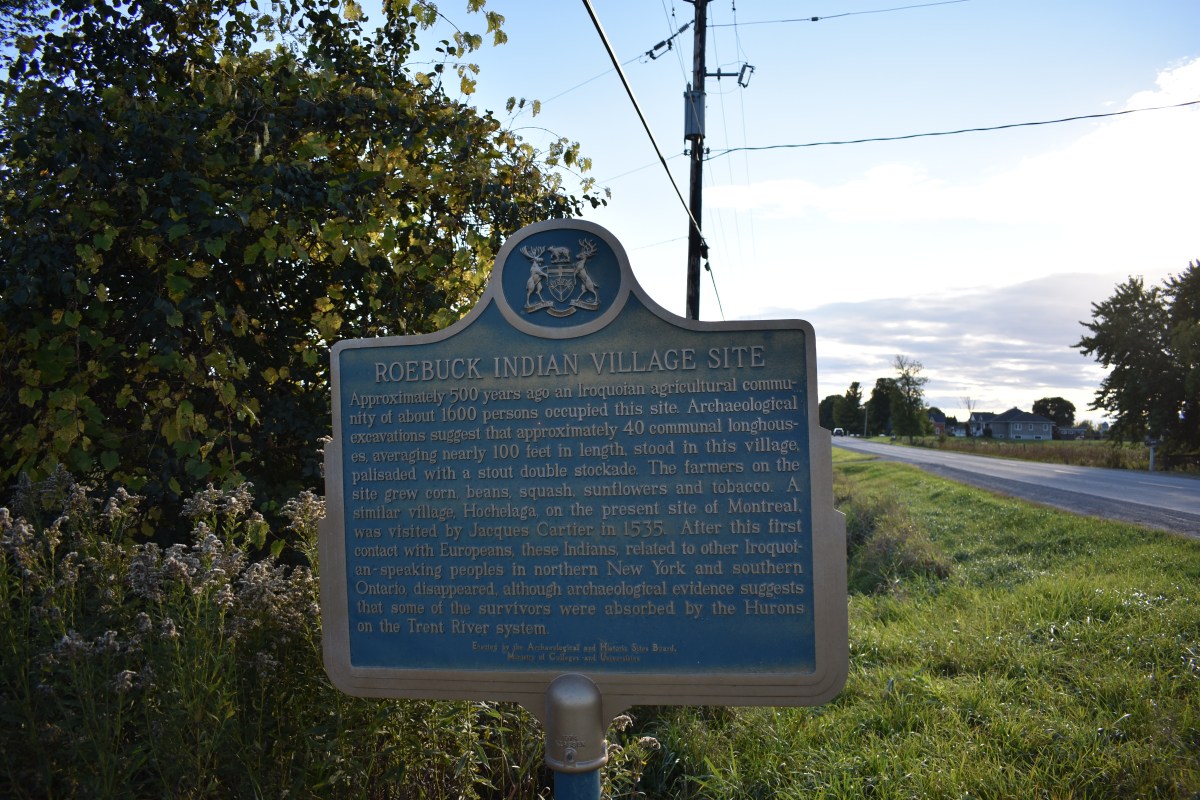
Google Maps did not have a location for the Roebuck Indian Village, but I found a website that said the plague was on County Road 21 about a kilometre east of Roebuck. I actually drove past it the first time, I had to turn around in Roebuck and drive slowly. I found it in-between Jolanda Farms and Pugwash Farm. It was unremarkable. Other than the plague, there is absolutely nothing to distinguish it from any other field entry point or old driveway. I got out of my car and looked around, and I found nothing that indicated that there had been a village or an archeological dig.
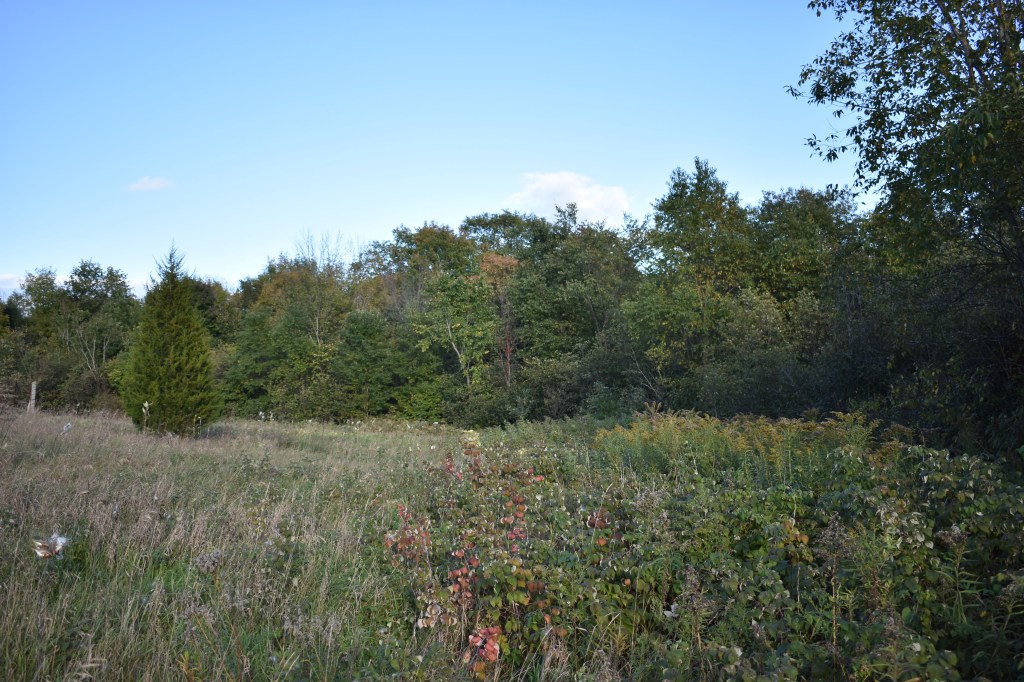
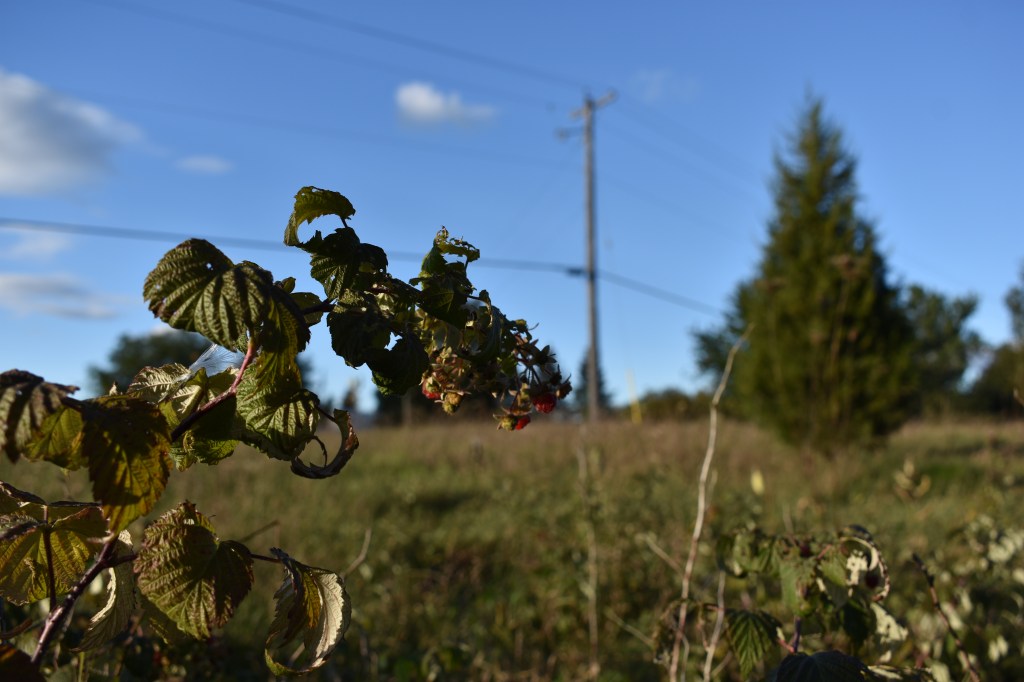
The old driveway appeared to lead past some overgrown bushes to a field, and at first I assumed that the field was the location of the village and the dig. Then I realized that with the age of the site it could be under the trees or the bushes, my mind just gravitated towards “empty space=where stuff happened”. While poking around to see if there was a path to the field I found several paths going from where I parked to an area around some bushes, and I wondered if other people had also recently visited. I followed the paths and found a large clump of raspberries. They were clearly picked over, I had a few of the last remaining ones. So I guess the paths were from foragers, not from fellow history enthusiasts. The raspberries were good.
I took a few pictures around the area, but all they show is typical Eastern Ontario scenery. Other than the sign there is no evidence of anything of note.

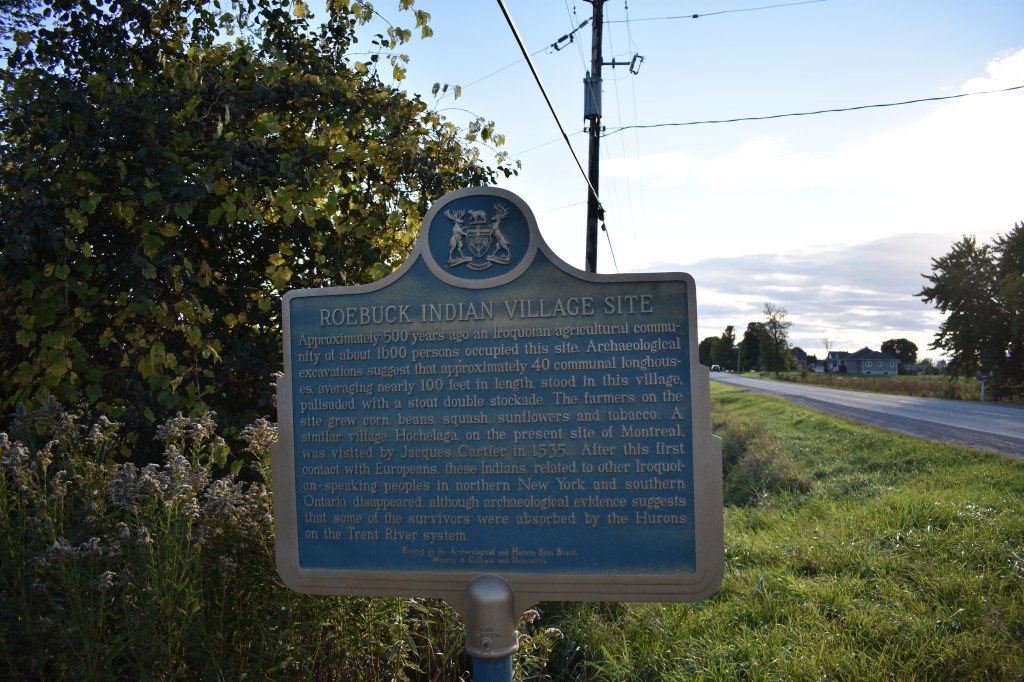
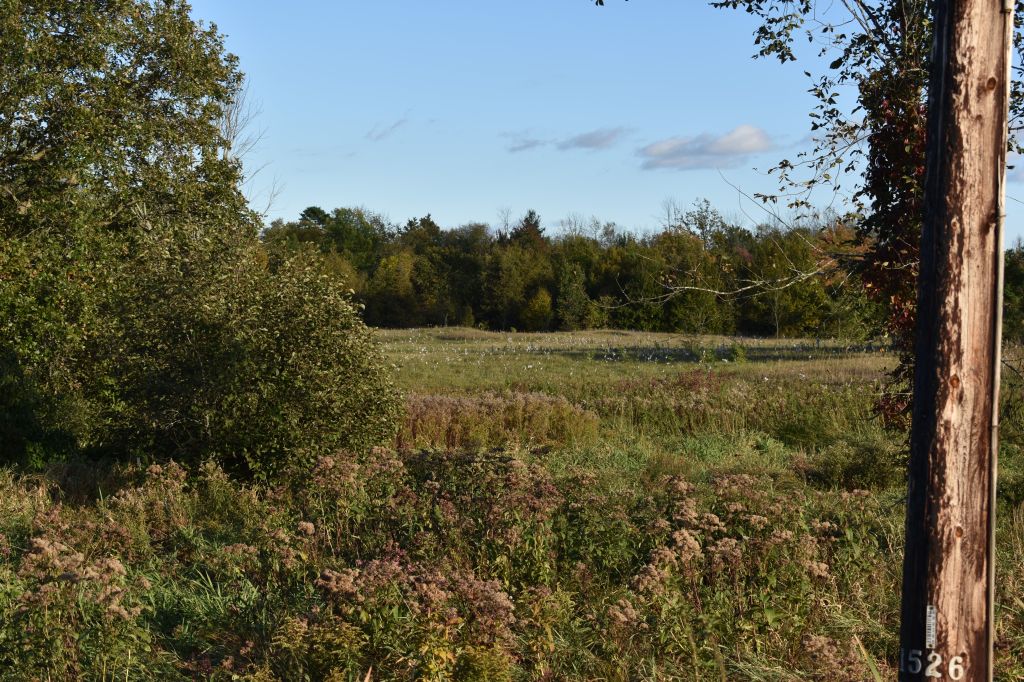
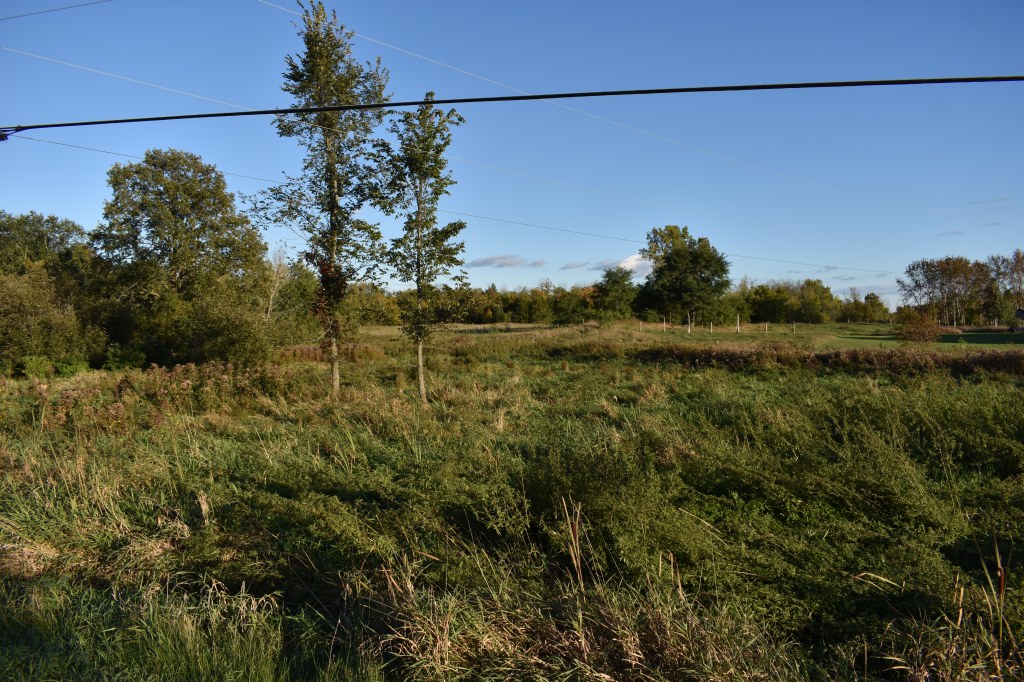
I have now added “Roebuck Indian Village Site” to Google Maps, so if for some reason you want to visit you should have an easier time finding it. I have read many random historical plaques in my lifetime, and this one takes the cake for easiest to miss.
I suspect the absence of anything notable is one of the reasons why it is hard to connect with Indigenous History. Canadian society has a habit of making permanent structures and changes to the landscape that almost always leave remnants. We can use North Gower as an example. The old town hall is still around, even though it is now an archive. The historical blacksmiths and sawmills are gone, but there are businesses in the same location owned by the descendants of the original inhabitants. Even without knowing anything about local history you can walk around uninspiring downtown North Gower and get the sense that people have lived there since the old timey days when houses were built with stone and load-bearing brick. Most people who grow up in English Canada receive a clear mental image of what heritage is. We gravitate towards churches, town halls, courthouses, brick townhouses, old but well-maintained farmhouses, mills of all types, stone buildings, old foundations, etc. But there are, as far as I know, almost no places where you can visually see evidence of Indigenous habitation of Eastern Ontario. The lack of Indigenous buildings, towns, or landscapes marked by habitation make it harder to recognized what happened in prehistory.
I am not saying that absence of cutesie heritage sites means there are no important Indigenous sites in the area. Ottawa is built over Indigenous land, and we can still find hints of that prehistory. The Voyageurs Pathway in Ottawa is a historic travel route that was used to portage around the Chaudière Falls. You could still use it to portage, but for the most part it is now used for cycling and romantic strolls. The entire north side of the Ottawa River in Ottawa contains clear evidence of major Indigenous occupation and of their extensive use of the area. But I suspect most people walking through that area will be enjoying the beautiful views of Parliament, exploring the grounds of the museum, or checking out the construction at Zibi. There are probably few informed folks who look down at the ground beneath their feet and say “hey look! A really old transportation route! And that parking lot is a millennia-old spiritual site and burial ground!”
The absence of visitable sites makes collective memory hard. But the absence of obvious Indigenous history and historical interactions with incoming Europeans is, in my opinionated opinion, one of the biggest issues in Canadian history west of Quebec. In the Maritimes and Quebec there was over two centuries of nation-to-nation relations. A lot of major communities in those provinces are linked to those historical ties. Montreal was first settled as a trade and evangelization outpost. Halifax was founded as part of ongoing wars between England, France, and their North American Indigenous allies. You could think that talking about wars with the First Nations is not a good way to remember Indigenous history, but those wars remind us that the First Nations used to exercise their historic and continuing sovereignty to the full extent. Wars are a normal, if highly undesirable, part of nation-to-nation relationships. I’m not saying we need to start wars, but relationships with sovereign nations tend to get messy without careful and consistent diplomacy. There are not many Indigenous sites in those towns, but you can look around at the built environment and get a sense of the historical interactions. Quebec City and Halifax are clearly built to be defended. That visible historical fact necessitates a discussion of the military history of the area.
But once we go westward from Quebec that history of co-existence, cooperation, and conflict quickly disappears. Instead, settlements exist at points of interest to incoming settlers. There are Indigenous histories in the settled areas, but they are separated and discontinuous with the history of the new nation (Canada) that emerged on that land. It is as if there is a clear line between the time that the First Nations used the land and the time that settlers showed up.
Look at the different settlements west of Quebec. Ottawa is located at a key transportation point, but the city is not there because of long-standing relations with First Nations. It is there because mills need waterpower and the Rideau Canal needed a terminus. Go ahead and try to find a single example of First Nations in the Ottawa area interacting with the City of Bytown or Ottawa. Toronto is at the start of the Toronto Passage, an important overland route from Lake Ontario to Lake Huron that was used by the First Nations and by traders. But once the Toronto Purchase from the Mississauga was made (to obtain land for incoming United Empire Loyalists) those original inhabitants simply disappear from the story. The history of Toronto is told with only scant references to the previous inhabitants, and they disappear as soon as the young town appears.
Many major cities in Western Canada follow this pattern. Edmonton and Calgary exist where there was once a Hudson’s Bay Company outpost. But those outposts, which are a clear indicator of relations with First Nations, did not become major communities until treaties were signed and the railway was built. Distant Churchill, with its long history (Google Prince of Wales Fort, you’ll be amazed something that size was built so far north) could have faded into history if a railway had not been built to it in the hopes of creating a northern port. Even Wikipedia recognizes this, the Churchill article states that between the fur trading years and the creation of the railway Churchill wavered on the edge of obsolescence. I’m serious, go look.
Regina and Brandon exist in their current locations because that is where the railway put a stop. Saskatoon was founded by a temperance movement who wanted to found a dry community. That is a cool story, but it drives home the point that a bunch of European-descent people just wandered out west and found a spot to settle down. Red Deer exists because it is half-way between Edmonton and Calgary. But all of these communities were next to nothing until treaties were signed, the railway was built, and Sir Wilfred flooded the west with the best (and then the rest) of Europe.
Every rule needs an exception, and Winnipeg is the exception to the treaty-railway-settlement pattern. The complex, and ridiculously interesting, history of the real Metis makes me wonder what Canada could have looked like if the developing nation of Canada had managed to co-exist with the First Nations. And the Red River Valley Rebellion is the inspiration for my favourite love song, so maybe I’m partial to the Red River colony.
Again, those who know a thing or two understand that the First Nations did not simply melt away and voluntarily choose out-of-the-way reserves for themselves. There is a history there. But that history is usually overlooked. If you read most histories, the land just becomes empty land. The silent de-peopling of the land creates a convenient narrative device to open up a continent. Whoever was willing to settle there and utilize the land and natural resources in a way that is considered productive could get their little square of free land. I have plenty of childhood memories of people using the terms “free land” or “empty land.” Yes, the land was empty. But it had been emptied. And the land was free, but it was obtained at a high human cost.
I will quickly say a few final points to close out this long ramble. First, I would like to see that sign get swapped out at some point with one that has a better name. “Roebuck Indian Village Site” could become “The Iroquoian Village at Roebuck” or something like that. Secondly, I acknowledge that over the past few years Canada has generally gotten better at acknowledging Indigenous history. But acknowledging a historic presence and a continuing connection to territory is not the same as improving how we portray the past. Many websites still just mention the existence of previous inhabitants and then move on the history (i.e. written records) part of the story. That does not tie the two histories together, even if an acknowledgment is better than nothing.
I believe that the field of Canadian history can get better at incorporating Indigenous history. Something I have noticed, particularly with local history websites, is that many websites have very similar facts and wordings. I think folks are getting carried away with ctrl-c, ctrl-v. We get the same basic facts over and over again, instead of different in-depth stories.
I was a nerdy kid who picked up a lot of information, but back in my childhood next to nothing was said about the previous inhabitants of my home territory. It was not until I read Oka: A Political Crisis and It’s Legacy by Harry Swain that I got enough information about the history of Indigenous peoples in Eastern Ontario to start to piece together a more complex story of where I grew up. And yes, I had to read a book by a deputy minister of Indian Affairs about one of the most traumatic moments in recent Canadian-Indigenous relations to find out about my local history. What does that say about how we access Canadian history? It is too difficult to access solid historical fact and analysis about the Indigenous peoples in Canada, and that needs to be remedied. Truth is a major part of Reconciliation, that is why it is called Truth and Reconciliation. Canada needs to get better at telling Indigenous history.
 Ian Weatherall