
When developing the supporting points for a thesis, it’s important that they properly relate to the thesis and that they flow into each other. The relationship has to make sense, and be clearly stated and reinforced. Never trust that the reader will make the connection for themselves, and never implicitly say “trust me bro, you’ll get it soon, keep reading.”
When developing the supporting points for a thesis, it’s important that they properly relate to the thesis and that they flow into each other. The relationship has to make sense, and be clearly stated and reinforced. Never trust that the reader will make the connection for themselves, and never implicitly say “trust me bro, you’ll get it soon, keep reading.”
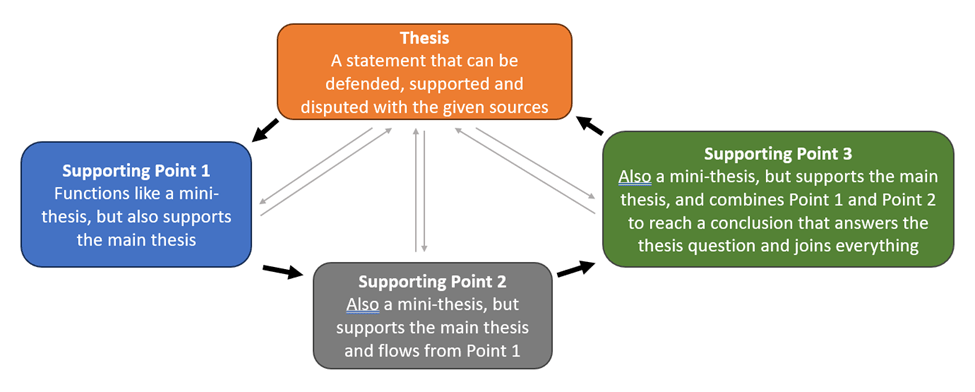
A thesis is a statement (i.e. something that makes a point) that is defensible, supportable, and also disputable. Each supporting point should also have those characteristics. They should each be distinct from each other, but make sense together. They should especially make sense when read with the point beside it.
If we look back at the previous example from A Handmaid’s Tale, we see that the three points meet these criteria.
Point 1: Gilead is set up for the benefit of men, and women suffer under that system. You can defend that statement. You could also support it from the book. But if you want to dispute it, you could argue that women are better off in a system that perpetuates the human race and that the new system is needed for the new reality. This sets up the next point, where we need a process to resolve that tension.
Point 2: By identifying the conflict in identity (is someone defining themselves by their gender or status) we see the need to apply some analytical structure. Marxism or feminism work here. Both of those concepts can build on what was discussed in point 1, and they relate back to the thesis.
Point 3: we are not yet at the conclusion. We need to ask what happens when we apply the conflict of the book with the analytical approach. In Handmaid’s Tale, we can see that identity is not set, but negotiatable and malleable within parameters. A woman can choose whether she’ll identify with her status or her gender, it is not given by someone else.
You can see that each of those points can be a mini-essay in it’s own right. For point 2 we could argue over whether the feminist lens or a Marxist approach or some other approach is the best for addressing the role of women in society. Point 3 revolves around human agency, which is always disputable but also defensible, depending on how we approach it. All three points also clearly relate to the thesis. Anyone could read the introduction then jump to any point in the paper and probably know what’s going on.
 Ian Weatherall