
The easiest way to put it is “analysis is your thoughts.” You’re smart, probably smarter than you give yourself credit for. But analysis is your thoughts stated in some structured way and applied to the book or topic. Even if you take some pre-constructed analytical structure, like a lens, when you choose to apply it you will be using it to support your own thoughts. You also choose what question you will address with it, how you’ll use it to support your argument, and what parts of the book or topic you use for your analysis. The trick is to find the balance between giving source material, explaining analytical structures, and actually analyzing the work in your own words. Most students fail to achieve the balance.
We’ll use the example thesis template from Part 2 to show different levels of analysis.
Level 1: looking at the source material to develop a conflict that needs to be resolved. Are there conflicting ideas in the book? Is a certain prevalent idea problematic? Do you disagree with someone else’s interpretation? Finding a conflict is using your brain to develop ideas about the work, it goes beyond simply stating what happened. To use Handmaid’s Tale as an example: “the men use the women for childbirth” is a statement of what happens. “The men are cruel to the women even though they need the women” is a basic analytical statement because you’ve identified a possible conflict. That could lead to an argument “the men are cruel to the women to control them to keep them available for childbirth”. Now that is a basic analytical argument.
Level 2: selecting key points from the book to explain the conflict, and arranging them in some sort of narrative structure. Honestly, just doing this might get you a B. You could select all sorts of quotes and incidences or themes about how the men need the women and how they seek to obtain what they want.
Level 3: This is where you try to get to deeper truth, usually about people, society, nature, existence, or the human experience. In a Handmaid’s Tale, you could apply a feminist lens to see that people operate within a system defined by gender. This speaks to personal choice, society, and the interplay between the two. You could look at what humans have to do in order to perpetuate the species or to thrive in their environment, and discuss the experience of human survival and how it affects personal choice and society. You could look at the stupidity of past people and how the people in the book now have to do dumb shit to deal with consequences, which is also looking at people and society. In Level 3 you need to step outside of the work, at least a bit, and connect themes to something bigger. This is where we resolve the conflict by reaching a deeper, unstated but implied truth. A good analytical structure brings us there.
If we look at the example template for A Handmaid’s Tale, we’ll see nine parts in the body. 3 points, and each point has three parts: the two conflicting elements from the book, and some form of analysis linking the two. The linking analysis is where you and your intellect really shine, but remember that selecting good points and passage and themes from the book is itself a form of analysis. So to make this simple, a good body section might be 1/3 talking about the book, 1/3 talking about how those parts relate and are relevant, and 1/3 analyzing them. Each point has a different type of analysis, and each bit of analysis furthers reconciling the conflict.
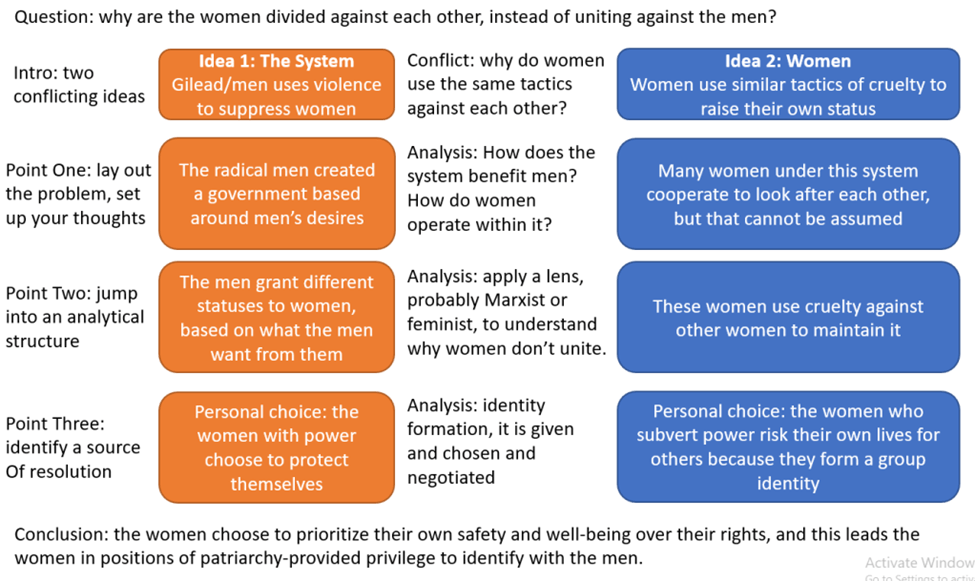
There is always a balance to be found between source material, analytical structure, your thoughts, and external material. It’s hard to get it right, but make sure that you’re always relating them to each other, making it clear that your thought process is behind it, and not sounding like a nutjob conspiracy theorist.
 Ian Weatherall