Listen from 0:50 to 2:34, and watch the subtitles. Thomas Jefferson wrote the Declaration to be profound, and compelling when read aloud. Long ideas are broken up into shorter sentences. The most profound statements are in short sentence clauses. Some of the less important parts are in longer sentences that can be read quickly, but they build up to short parts that can be read dramatically.
You don’t have to be as good as Tommy J at dramatic writing. But there are a few things to think of.
-Every sentence should be able to be read in one breath, or have a clear break where you can pause AND it makes sense to pause.
-Important point should be in short segments that can be stressed aloud. A lot of students think long sentences are intellectual and try to put their most important ideas in long form. It’s actually the opposite when speaking.
-Use sentence length and pauses to create tone. Are you rambling on to create a thoughtful tone? Building up to a point with slightly longer sentences? Emphasizing a point with a short declaration?
-Use conversionational language to link ideas together. The reader can’t easily go back to re-read anything. “like I mentioned when discussing….” “finally, we’ll look at…”
There are at least three easy ways to get good at this. First, just look at how many syllables you have between each point of punctuation. Second, think about whether a sentence is improved by being broken up by pauses or made worse. Third, record yourself and listen for times that you sound strained, droning on, or where you think it just sounds bad.
If you wish to feel bad about yourself, record yourself reading it then ask someone who has no respect for you to comment on it.
Even if you don’t take the time to craft strong statements, you can at least create shorter sentences that sound good when spoken.
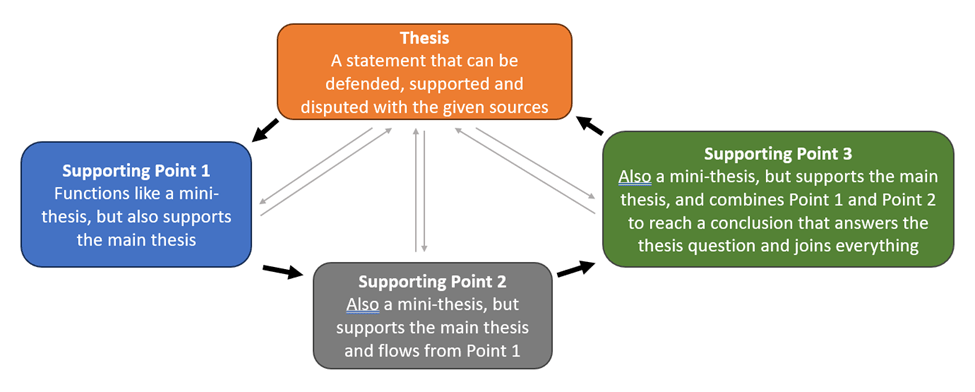
When developing the supporting points for a thesis, it’s important that they properly relate to the thesis and that they flow into each other. The relationship has to make sense, and be clearly stated and reinforced. Never trust that the reader will make the connection for themselves, and never implicitly say “trust me bro, you’ll get it soon, keep reading.”
When developing the supporting points for a thesis, it’s important that they properly relate to the thesis and that they flow into each other. The relationship has to make sense, and be clearly stated and reinforced. Never trust that the reader will make the connection for themselves, and never implicitly say “trust me bro, you’ll get it soon, keep reading.”
A thesis is a statement (i.e. something that makes a point) that is defensible, supportable, and also disputable. Each supporting point should also have those characteristics. They should each be distinct from each other, but make sense together. They should especially make sense when read with the point beside it.
If we look back at the previous example from A Handmaid’s Tale, we see that the three points meet these criteria.
Point 1: Gilead is set up for the benefit of men, and women suffer under that system. You can defend that statement. You could also support it from the book. But if you want to dispute it, you could argue that women are better off in a system that perpetuates the human race and that the new system is needed for the new reality. This sets up the next point, where we need a process to resolve that tension.
Point 2: By identifying the conflict in identity (is someone defining themselves by their gender or status) we see the need to apply some analytical structure. Marxism or feminism work here. Both of those concepts can build on what was discussed in point 1, and they relate back to the thesis.
Point 3: we are not yet at the conclusion. We need to ask what happens when we apply the conflict of the book with the analytical approach. In Handmaid’s Tale, we can see that identity is not set, but negotiatable and malleable within parameters. A woman can choose whether she’ll identify with her status or her gender, it is not given by someone else.
You can see that each of those points can be a mini-essay in it’s own right. For point 2 we could argue over whether the feminist lens or a Marxist approach or some other approach is the best for addressing the role of women in society. Point 3 revolves around human agency, which is always disputable but also defensible, depending on how we approach it. All three points also clearly relate to the thesis. Anyone could read the introduction then jump to any point in the paper and probably know what’s going on.
The easiest way to put it is “analysis is your thoughts.” You’re smart, probably smarter than you give yourself credit for. But analysis is your thoughts stated in some structured way and applied to the book or topic. Even if you take some pre-constructed analytical structure, like a lens, when you choose to apply it you will be using it to support your own thoughts. You also choose what question you will address with it, how you’ll use it to support your argument, and what parts of the book or topic you use for your analysis. The trick is to find the balance between giving source material, explaining analytical structures, and actually analyzing the work in your own words. Most students fail to achieve the balance.
We’ll use the example thesis template from Part 2 to show different levels of analysis.
Level 1: looking at the source material to develop a conflict that needs to be resolved. Are there conflicting ideas in the book? Is a certain prevalent idea problematic? Do you disagree with someone else’s interpretation? Finding a conflict is using your brain to develop ideas about the work, it goes beyond simply stating what happened. To use Handmaid’s Tale as an example: “the men use the women for childbirth” is a statement of what happens. “The men are cruel to the women even though they need the women” is a basic analytical statement because you’ve identified a possible conflict. That could lead to an argument “the men are cruel to the women to control them to keep them available for childbirth”. Now that is a basic analytical argument.
Level 2: selecting key points from the book to explain the conflict, and arranging them in some sort of narrative structure. Honestly, just doing this might get you a B. You could select all sorts of quotes and incidences or themes about how the men need the women and how they seek to obtain what they want.
Level 3: This is where you try to get to deeper truth, usually about people, society, nature, existence, or the human experience. In a Handmaid’s Tale, you could apply a feminist lens to see that people operate within a system defined by gender. This speaks to personal choice, society, and the interplay between the two. You could look at what humans have to do in order to perpetuate the species or to thrive in their environment, and discuss the experience of human survival and how it affects personal choice and society. You could look at the stupidity of past people and how the people in the book now have to do dumb shit to deal with consequences, which is also looking at people and society. In Level 3 you need to step outside of the work, at least a bit, and connect themes to something bigger. This is where we resolve the conflict by reaching a deeper, unstated but implied truth. A good analytical structure brings us there.
If we look at the example template for A Handmaid’s Tale, we’ll see nine parts in the body. 3 points, and each point has three parts: the two conflicting elements from the book, and some form of analysis linking the two. The linking analysis is where you and your intellect really shine, but remember that selecting good points and passage and themes from the book is itself a form of analysis. So to make this simple, a good body section might be 1/3 talking about the book, 1/3 talking about how those parts relate and are relevant, and 1/3 analyzing them. Each point has a different type of analysis, and each bit of analysis furthers reconciling the conflict.
There is always a balance to be found between source material, analytical structure, your thoughts, and external material. It’s hard to get it right, but make sure that you’re always relating them to each other, making it clear that your thought process is behind it, and not sounding like a nutjob conspiracy theorist.
A thesis is a statement that can be defended, supported, and disputed. The key element of an academic thesis, the type you’ll be required to write for a grade 12 essay, is that it needs to be tied to the works and sources used in the paper. So a thesis cannot just be your opinion or an argument you strongly believe. An argument is also a statement that will be defended, but the addition of facts, quotes, additional sources, and your own analysis make it into a supported thesis.
Opinion: what you think.
Argument: clearly stating and supporting what you think. Often loudly.
Thesis: assembling multiple supporting points to support and defend your thesis against disputes.
How do you create a thesis?
There are a few basis thesis structures that high school students should be aware of, because they’re easy to use for high school essays.
Every good thesis answers a question. But it should be a question that does not have a readily available answer, and that requires thought to address.
Basic Thesis Structures:
Resolution of conflicting ideas: this is where you find two ideas in the book or topic and find a way to resolve them.
Disagreement: find a quote or idea or concept in the book or topic that is prevalent and key to important themes, then dispute it.
Defense: find something in the book or topic that is under attack or dismissed and defend it.
Engage an expert: find someone who is knowledgeable about the book or topic, and examine their ideas to see how well they work.
Analyze the author and context: why was this created? What about that time made it relevant?
Dispute the question: if you think the essay question, prompt, or topic choice is unfair or biased make a ranty essay about that. These are really fun to write and really risky if your teacher is sensitive or if you basically avoid doing what you’re supposed to do.
Clarification: find something that is unclear and try to clarify it.
In Part 2 we’ll look at how you can use a basic structure to develop a solid theses and paper. The important thing to note here is you want a conflict between two ideas. Two ideas in the book, your idea and someone else’s idea, a stated idea in the book and an unstated idea that is required to accept the book, etc.
Of the many ways to structure a good thesis, my go-to method is to take two conflicting ideas and pit them against each other to reach some form of resolution. The thesis can be a two-part sentence that states the two ideas and how they relate. To give an example of how this works, I’ll use the Handmaid’s Tale.
Question: why do some women ally themselves with the men of Gilead and not support other women?
Idea 1: Many of the women in the book are oppressed by men and face similar problems, so they form a group identity and look after each other.
Idea 2: the best life is the life that the patriarchal system can give, and some women have higher status because of their granted position, so they choose to protect that status.
Thesis: Even though most of the women in the Handmaid’s Tale support and protect each other because of their shared experience of oppression, women who benefit from their status in Gilead’s society prioritize their own status over their gendered experience as a woman.
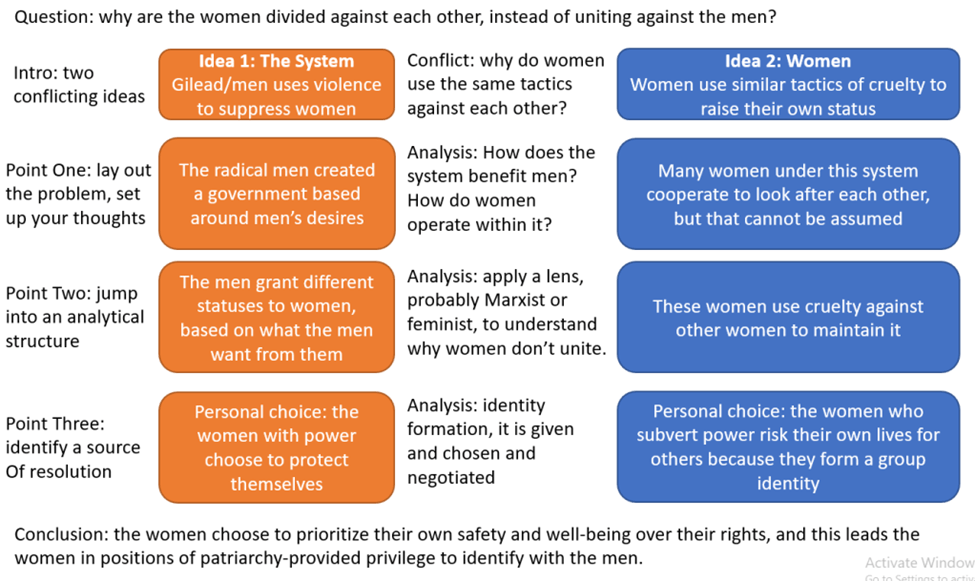
We can make a diagram out this method. On one column, orange, we have the first idea of violent suppression of women by men, for the benefit of men. The corresponding and conflicting idea is that some women use similar tactics against members of their own gender. To bridge this gap we need to acknowledge a conflict. The point of the essay is to resolve the conflict.
In Point One, we lay out the situation. What is the system? What are women’s roles in the system? How do they live and function? Who benefits? In this point, the analysis is linking some form of broader societal happenings to the characters experience.
Point Two is where you want to develop some form of analytical structure. In this case, we can apply apply a feminist or Marxist lens to look at group identity and how people align their identity with a particular group.
Point Three is where you need to combine the first two. We’ll dig into the Marxist system and the concept of gendered identity to realize that each character can choose how they identify within the system, based on what they want. We resolve the conflict by understanding identity formation, which links the societal to the personal.
A lot of students think a concluding paragraph just re-states everything. But it also needs to state the new truth that we realized through the analytical approach.
Here is an empty template that could be used to populate a thesis-generator. ChatGPT won’t give you a thesis-generator this good. Suck it, GPT.
First fill out a question. Then you want to find some overarching conflicting ideas that don’t seem to be able to coexist in the same work. Once you have that, you should use Point One to set the stage and flesh out the conflict. Point Two will be about whatever drives the story: characters, society, weather, the Gods, Nature, fate, etc. These are more thematic elements and often good for an analytical structure.
Point Three is where we hit truth. What does the analytical structure tell us about the conflicting characters? Once you have these things laid out it’s not so hard to make a good thesis.
This looks linear, it never is. Some students fixate on making a good thesis before doing anything else and forget to hone it as they work or make a simplistic thesis. Other students (like me!) get lost in the weeds of setting up analysis and forget to make a good thesis. Just find what works.
Template:
Question:
Thesis:
Supporting Points
Idea 1:
Analysis (bridge the gap)
Idea 2:
Point 1:
Point 2:
Point 3:
Conclusion:
Hey Mr. Crowe, if you see this, I intentionally made my example different enough from the essay prompts that it can’t be copied. I’m just a raging Marxist who likes feminist theory, I went with my interests.


 Ian Weatherall