The Payette Regret

On June 26, 1926, Canada experienced its greatest constitutional crisis when Governor General Lord Byng refused Prime Minister Mackenzie King’s request to call an election, thus triggering the King-Byng Thing. On January 21, 2021, Canada underwent the Payette Regret when Governor General Julia Payette finally accepted that she is unsuited for the job. In Canada, constitutional crises have to rhyme. The GG is a job without a formal job description, so we cannot objectively say she was unqualified, but her repeated refusal to act in a manner befitting a royal rubberstamp made it clear that her personality and method of operating did not work in Rideau Hall.   

Her successor will have to be exceptionally regal, in a humble way, to undo the damage that Payette has done to an office that struggles to justify its existence in the best of times. The GG once played a central role in Canadian government, but it is now an anachronism of our past and a necessary side-effect of our monarchial government system. We don’t need a GG, but so far it has been easier to keep the role around than get rid so it, and I doubt Canada is ready to become a republic.

So I think that the most effective way to undo the damage that Payette did is to abolish the position of Governor General and instead have Queen Elizabeth actually carry out her job as the head of state. She has an exceptional track record of showing up for work, doing her job, being nice, and not causing problems. Before you tell me that she doesn’t have time to actively reign over two realms, let’s look at what the job entails.

In 2019, there were 105 bills that required Royal Assent. That means 105 signatures. After every election Ministers of the Crown have to the sworn in. That requires an afternoon of Zoom calls every few years. There are similar recommendations and swearing-ins for Senators, members of the Privy Council,  judges, and ministers in cabinet shuffles. That requires…..a Zoom call every few weeks or months. These things are managed by Parliamentarians, all Queen has to do is sign her signature or receive an oath. We could stop the charade of having a non-partisan head of state read the highly partisan Throne Speech and just let the PM do that. Same thing with the engagements that the Governor General currently does, let politicians have more public engagements. 

The bulk of the GGs signing responsibility seems to be the Order-In-Councils. If my paltry research is correct, there are about 1,900 Order-in-Councils a year. I doubt most of them ever require any second thought, which is the monarch’s nominal role. Let the PM sign them, and then hold him accountable in Parliament if it turns out to be a bad decision. You know, the way we have done it since 1841.

The only time that the Governor General or the Monarch actually exercises their authority is when choosing a Prime Minister in a minority situation, when proroguing Parliament, or refusing to grant royal assent and thus triggering an election. So think about who you want to exercise that power. A woman who has over sixty years of experience being a monarch and who spent eleven years training to be a monarch? A women who, along with her father and grandfather, has a track record of non-controversy since 1910? Let’s pretend Edward VII didn’t happen.  Or do you want an astronaut? A journalist? Whichever politician is most owed a favour by the PM? Like it or not, Queen Elizabeth II is the Canadian who is the most qualified to represent herself. She would be the best GG ever. So let’s throw off the vestigial remnants of our colonial past and instead fully embrace our modern monarchy.  

Thesis Model Part 4.5: Source Analysis

The interpretation of sources and historical facts is subjective, but that does not mean that all interpretation are of the same quality and are thus equally valid. Every bit of historical data that we have came into existence in a specific context, often created by a person who had their own way of looking at the world. Each source also, to a greater or lesser degree, portrays the actions of people who acted on their own initiative for their own reasons.

Source analysis is not just applying your own ideas to what you see in a way that supports your argument. In the “Opinion” blog post I said that intelligent people are full of informed opinions, which is important for understanding how we arrive at arguments. In source analysis, supposedly informed opinions are of little use if you don’t have the right contextual knowledge. There is an objective past that we glimpse in pieces, and actions are easily misunderstood without having general knowledge of that past. A lot of poor source analysis stems from poor quality background research, where people too quickly come to a conclusion.

This is where working with someone who knows more than you comes in handy. One of the best things about a university education is that students’ work is read by experts in the field (or TAs suffering from imposter syndrome) who are skilled at giving feedback. If you want to develop research and writing skills for free you can be active on online forums and get plenty of feedback from random commenters, but there is little guarantee of receiving quality feedback.

If you willfully or ignorantly misinterpret source material it undermines the strength of your thesis, even if the argument is a strong one and you found some quality sources. However, information gleaned from sources often have their own basic premises that can conflict with the basic premises of your argument. Too many students think that certain sources inherently conflict with their argument and must therefore not be used. I disagree with that. Interpret the source fairly and to the best of your ability without misrepresenting it, then explain how it still supports your argument.

When you become skilled at analyzing sources and incorporating potentially conflicting views into your paper, then you broaden your research scope because you don’t have to exclude sources that might undermine your argument.

Source analysis is what turns the historical record into history. Because there are a limited number of ways to subjectively interpret the objective past through passive sources, there are only a limited number of possible histories that closely align with the past. Yet within those constraints, historians still manage to have compelling and never-ending debates with each other. Historians will never agree because historians don’t have to be in agreement for their ideas to be valid.

Thesis Model Part 4: The Historical Record

Historians study the past, but they work with the historical record. The historical record is whatever we have from the past. Thanks to powerful destructive forces like fire, war, recycling, shredders, and biological degradation, very little of what was produced in the past exists in the present. Good historians know how to work with the historical record and form histories, despite the massive gaps in the record.

In recent years the field of history has benefitted from new ways of reading the historical record, but in my mind there are still several basic types of records. There is always an ongoing process of discovery, but this takes time and money, both which are in short supply.

  1. The intentionally preserved. Libraries, museums, archives, time capsules, my mother’s photo albums, etc. are created with the intention of preserving records for the future. They are expensive, which means someone must be incentivized to fund them. Think of the cost of supporting authors, building libraries, staffing them, and then maintaining them year after year. Thought is put into what will be preserved and what it will tell future people. As time goes on, additional funding is required to continue the preservation, which requires additional incentives to preserve certain parts of the past and discard other parts.  Many of the sources that are preserved are created with the intention of influencing people’s understanding of the past. History books, textbooks, sagas, religious texts, etc. create ideas that are considered worth preserving. Archives tend to choose documents that are important for giving a deeper idea of what happened, although the document were not created for posterity . Museums are highly selective in what they can keep. So these sources are, in a way, passive, but there is a lot of active thought into deciding what will be preserved.
  2. The randomly preserved. Bodies that fall into a bog happened with no thought of future interpretation. Many archeological sites around important buildings dig up all sorts of ordinary items like tools and kitchenware that were accidentally lost. People who abandon buildings don’t do it with the intent that future historians study their home.  Garbage dumps are perhaps the best example of things that were not meant to be preserved. Ships are built with the intention that they float, but when they sink they become treasure troves of historical information.
  3. The revealed. New technology gives us new ways of seeing the past. Drones, infrared cameras, DNA testing, sonar, have revealed things that could not be seen by a human on the ground. We have had amazing nuggets of historical information in our genes since the dawn of mankind (the one time this phrase was used properly!) but until Crick, Watson, and Franklin came along we had no way to access it. Tree ring interpretation is a field that reveals a lot about prehistoric times using information that is readily available almost everywhere, but it took a lot of environmental science to really figure out how to use it.
  4. The disturbed and the private. Many graves that have revealed a wealth of historical information had sacred significance to the people who created them, and they were likely meant to be left alone. Private diaries or letters that are kept after someone passed away could be included here if they violate the person’s privacy. Information taken by force can be included here. This area can have ethical considerations for how we obtain information from them.
  5. The inherited. Family histories and family memorabilia fall into this category. I have much of my grandfather’s history in my head because he gave it to me. much of the inherited historical information is never written down, and thus easy to lose.

Of course this is a simplification, but I think these categories encompass a lot of types of sources. There are always hybrid sources, and sources that change over time. For example, the pyramids of Giza were built with the religious importance of providing an eternal link for Pharaohs between this world and the afterlife. As Egyptian society change they lost their original significance, but they were randomly preserved because nobody had the time or energy to dismantle them.

Students of history are usually quick to understand that the historical record is limited, but they often struggle to understand how to form cohesive historical arguments with the limited record. A good history should align closely with the historical record, and do its best to describe the past by interpreting the record we have to the best of our ability. Source analysis often requires an in-depth knowledge of the source creators and of the forces that preserved the forces. Religious iconography can look like pictures drawn by children if you don’t know how to interpret them, or they can be worth ten thousand words per square inch. Government sources can sound like they are packed full of catch-phrases and government-speak, or they can reveal underlying governmentalities that influence how they reach decisions.

The historical record is also subject to tampering and damage. Qin Shi Huang destroyed all records that predated him so he would be at the start of history. Every time the Pope moved between Avignon and Rome a good chunk of the Papal private library was lost on the way. Every Great Library of the ancient world was eventually destroyed by war or lack of funding. Governments love to classify information to influence the record.

The preservation of the record is beautifully random, which has fundamentally influenced our histories. The humid Amazon rainforest has nearly wiped out all knowledge of peoples who lived their five hundred years ago, but a wealth of information ten times as old in the Fertile Crescent and the surrounding arid regions has been preserved by the dry desert. The discovery of a single source, the Rosetta Stone, opened up ancient Egypt to modern scholars, but decades of work on the Minoan Linear A script has yielded next to nothing.

If we had a perfect historical record, where every action of every human, animal, plant, and other living and non-living entity was on record, historians wouldn’t exist. We would just have data analysts.

Thesis Model Part 3: The Objective Past

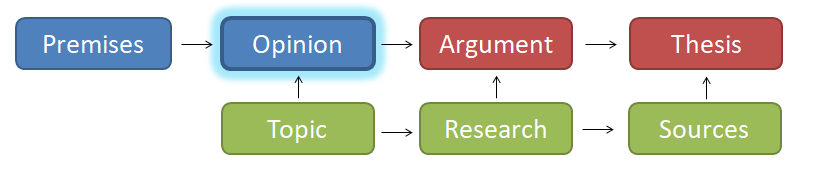
Before we continue with the premises à opinion à argument à thesis part of the model, we need to understand how history interacts with the past. There is such a thing as an objective past. Stuff actually happened, whether we have a record of it or not. Tens of billions of human beings lived, ate, successfully procreated, and died, regardless of whether or not we have any record of their actions.

Unfortunately for modern scholars, very little of this past exists in the archeological record, and less still exists in writing. New forms of acquiring historical information, like DNA studies and carbon dating, can help flesh out the past, but there are still massive gaps in what we know that will never be known without a time machine. Even with a time machine, we would be limited by the number of time machines and the availability of people willing to go back in time to observe a lot of really boring stuff. So no matter how hard we try, our understanding of the past is limited by the historical record, our ability to process the record, and our subjective interpretations of what we possess.

Historians want to understand the past, but they work with the historical record. History is what we tell ourselves about our past. Because people can have strongly differing opinions, there are usually multiple, overlapping histories that can give conflicting views of the past. They are often as much about our present as they are about the past. They can be weaponized. As time goes on they often have to change, but they can also be defended in the face of new evidence. Most importantly, however, good histories align as closely as possible with the part of the historical record that is in our possession. So even though histories are created and subjective they are limited in their range of interpretations before they leave the realm of history and become historical fan-fiction.

Let’s look at some examples. We could tell the history of Canada as that of two founding nations. The French and English came to Canada for similar reasons, and over the course of centuries their respective cultures and languages spread across the top half of a barren continent along east-west waterways. There was conflict, but over time they learned to work together, and now have modern, bicultural Canada.  

Or is Canada actually an inherently British state, violently imposed over other cultures? The Acadians were expelled. The Quebecois faced centuries of oppression and attempts at cultural genocide. The land was cleared of its original peoples. Immigrants from around the world were brought to work in menial roles that financially supported the British imperial business.

But wait! Isn’t Canada a multi-cultural, post-national state that is a conglomerate mashup of its constituent cultures? People from around the world came to Canada for their own reasons, and blended their identity into the nation. Or we could argue that Canada is the Diet Coke United States of America, where every idea the Americans had was adapted by Canada a decade later, no matter how much Canada claims to be unique and different. I think you get the point.

We can take the same approach to any history. Is the United States a global bastion of freedom, founded on the self-evident truth that all men are created equal? Or is it a business empire, founded by Bostonian merchants, that expanded until it encompassed half the world? Or is the United States an inherently British state violently imposed over other cultures?

Were the Crusades a religious war against Muslims, or a religious civil war among Christians? Is human society inherently progressive and always getting better, or is it constantly cycling between growth and Malthusian destruction? Is China a 2,500 year old state that possesses incredible consistency throughout history, or is it a modern creation of the Chinese Communist party that uses the mythology of successive dynasties to justify its aggressive expansion? Did the European colonial empires spread modern ideals and science around the world, or were they just all-consuming economic engines violently imposed over other cultures? Did the Indigenous Peoples of the Americas sign away their land for a pittance, or were they violently expelled from their land and then marginalized by settler societies?

I could keep going on, so I won’t. The thing to understand about these competing histories is that they all address the same past. To a large extent they use the same historical record, although it is natural to select sources that better align with how one chooses to portray the past. We know something happened, we agree on what sources we have concerning that past, but we tend to strongly disagree on how to interpret that past. It’s the Tower of Babel in academia.

Thesis Model Part 2: Opinions

You are forgiven for thinking that opinions have no place in academic writing. Some folks think that academic discourse has to be objective and non-personal, and the phrase “that’s just an opinion” is used to dismiss ideas. I don’t like the disrespect shown to opinions when the word is used that way. Human beings are highly opinionated creatures, and intelligent humans are full of informed opinions. That doesn’t mean the opinions are guaranteed to be correct, but they are also not guaranteed to be wrong or unsubstantiated.

A person’s informed and educated opinion is the start of the process that results in a strong argument, so they warrant inclusion in the model. Students tend to take classes in subjects that they are interested in, and they bring their own unique set of skills, knowledge, interests, and personal views to the table. When they receive a topic or research question they are likely to form an opinion quite quickly, and the final argument will likely be an expanded version of the opinion.  

The student takes that opinion to the library (or Google) and begins to flesh it out and test it. Ideally, the opinion will grow and morph into a good argument as facts and new ways of looking at the world are discovered. When worldviews and personal beliefs are applied to a topic they become the premises of the personal opinion. People’s premises tend to be personal and relatively stable, so those will rarely change during this process. Yet they should be challenged and developed in a way that sharpens their use. A humble person should be willing to accept that their opinion is wrong, but retaining your original opinion throughout the creative process is not necessarily a sign of arrogance.

To reiterate what I wrote in the previous post, opinions are personal, and arguments tend to be based on the writer’s opinion. So when marking a paper and critiquing the argument, be aware that you are likely touching something in which the student is personally invested. Be clear with the critique. Are the premises and argument mismatched? It is under-supported by the research? Is the argument sound but the paper does a poor job of explaining it? Is the argument insufficiently aligned with the historical record? Work with the student to help them get better at developing strong arguments and be clear that you are on their side.

Thesis Model Part 1: Premises

Understanding the role of premises within an argument is something that I think is undervalued when teaching history. When I was a teaching assistant at Carleton University, I repeatedly saw students struggle with understanding how premises, opinions, arguments, and theses build on each other. Logic studies and philosophy spend more time on premises, but getting your head around how premises play a role in historical arguments helps create strong arguments. 

The relationship between a premise and an argument is not absolute: a strong premise does not mean a strong argument, and vice versa. In academic writings premises must often be inferred because they are not explicitly stated, and they are not always directly discussed in the paper. Nevertheless, they are usually quite clear.

There is always some disconnect between an individual premise and the argument. So a strong or correct premise does not ensure a strong argument. Disputing one premise does not disprove the argument. And there is no such thing as an argument that is automatically correct because the premises are correct.

Let’s walk through the relationship of premises, opinions and arguments. I’ll use Canada’s contribution to the War in Afghanistan as an example because of the wide range of possible premises.

Argument: “Paul Martin’s government made the correct decision in 2005 to escalate Canada’s involvement in the war in Afghanistan.”

What premises are behind that idea? At that point, Canada was not under threat from anyone in Afghanistan. So were we placating our major allies? Spreading human rights and liberal ideals? Combatting terrorism? Correcting historical wrongs? Defending the state-based international order by supporting a weak central government? Exacting retribution on a nation whose former government supported terrorists? Taking part in a neo-Cold War effort to limit Iran’s influence in the region? There is a very wide range of ways to defend that simple statement.

I put premises before opinion because most people’s opinions are influenced by their basic worldviews. When a worldview is applied to a topic, it becomes an opinion. I tend to think that Canada needs to work together with its allies to achieve common goals, so when I apply that idea to Canada’s involvement in Afghanistan I am likely to be of the opinion that Canada made the right choice to send forces. I can argue for Canada’s involvement by discussing how Canada and NATO allies have a long history of working together to achieve their common defence and security goals.

Premises are never absolute. Worldview + topic does not always result in a particular opinion. Canada rightfully stayed out of Iraq because there were no common goals to achieve. So my basic premise that Canada needs to be military involved does not guarantee support for military involvement.

Premises and opinions have the same colour (blue) in the model because they are personal. A TA does not have the job of changing or influencing a student’s worldview or their opinions. However, when a worldview is used as a premise to support an argument, then it is fair game to comment on how the interact with the argument. Topics are also a different colour because they are external to argument or a worldview. There can be dozens of arguments about one topic and a million worldviews that lead to those arguments, without the topic inherently funneling people to a certain idea.

Intro 2: The Story of The Model

Here is the overly long story of how I came up with this model. It is not necessary for understanding the model, but it helps explain how this model interacts with an education that focusses on the written word.  

When I was writing my Master’s Thesis, I realized that I was struggling to craft a simple thesis statement for my complex research project. That bothered me. I was almost six years into getting an education in History at Carleton University, which has a well-respected history department. I had many quality professors, and I had some excellent teachers in high school. My grade 11 teacher, Ms. Bol, spent two weeks teaching us how to write well-crafted thesis statements, and I used that skill throughout six years of university to do well. But when I had to assemble a large amount of archival information and a literature review into a cohesive, 120-page thesis that was bound together by a simple argument, those skills seemed to temporarily jump ship. With a lot of help from my thesis supervisor (Dr. Norman Hillmer) we were able to craft a strong, simple argument and get through the process of writing a good thesis. Still, the experience left me wondering whether I had missed something in my six years of education.

During the year after I wrote my thesis a few things happened that helped me get my head around what was lacking from my education. I decided to do a second Master’s degree at Carleton (International Affairs, Security and Defence), which meant a third year of being a Teaching Assistant, so I came to job with some previous experience. Second, on the side I tutored a grade 12 student who took a grade 12 philosophy class. The class included lessons on the relationship between premises and arguments, lessons on subjectivity-objectivity and dualism. That grade 12 class helped give me some basic terminology and concepts that I think should have been more prominent in my university education.

Third, I TAed with Dr. Audra Diptee, who really wanted her students to understand the difference between history and the past. The past is objective: it really happened, and it will never change. History is our subjective, and thus fallible, understanding of the past. The field of history constantly grapples with the inherent duality of the past and what we think about it. A good historical paper always addresses that duality, even if it is not explicitly stated in the argument. When I look back at my education, most professors allude to that duality in some way, but each used their own terminology. The range of terms can make it hard for students to really connect the dots between multiple professors across four years of education.

Finally, in a discussion group with my first-years students, I asked if they had any questions about their upcoming paper. One of the better students asked me what a thesis statement was.  I could dismiss that and say “you should have learned that in high school” but that would not help anyone. If a good student asks a question it is pretty much always a good question. I realized on the spot that as students progress they are introduced to new concepts and are expected to research and write at a higher level. This should entail that they also need to re-learn how to write thesis statements that incorporate the new things they learn. I ditched the discussion I had planned and I started working with the group to explain what a thesis statement is, but I felt like I was struggling to explain it.

After that discussion group, I got out my whiteboard, and I decided to make a visual graphic thingy to help walk my students through what an argument is in historical writing. History needs more visuals. Once I decided to incorporate elements from the philosophy class and from Dr. Diptee’s “the past and history” lecture it went pretty quickly. There were two basic concepts I wanted my students to really get into their heads. One, there are multiple components that have to work together to have a strong argument. Two, a good historical argument aligns with the historical record, but also engages with other ideas in the field of history. Best of all, by giving the students new terms and concepts I established a common lexicon. That made my job easier by reducing the amount of writing I did when commenting on their papers.

That model did wonders. The papers that were submitted that semester had the greatest bipolarity in the four years I TAed. The students who attended discussion groups wrote good papers. The students who did not attend wrote, to put it diplomatically, papers that had clear room for improvement. Some of them were good writers, but the argumentative approach was lacking. The next semester I TAed a third-year legal studies course, and I almost cried (figuratively) when I saw how many third-year students made the exact same mistakes my first-years made. Did Carleton University fail those students? Or is it their own fault they learned next to nothing?

I didn’t really mean to make a comprehensive model of how to craft a historical argument. I just wanted to help my students get a grasp of what I expected from their 7-page, double-spaced papers. But as my second Master’s progresses I realized that I kept coming back to that model I made because it worked for every paper I wrote. I think it has served me well, so I figured I should share it. So here it is. I also got bored during lockdown and wanted to write, so this is also my entertainment.

There is an alternative explanation to all of this: I could be quite dense, and everyone else in the world immediately grasped what an argument is while it took me six years to get it. I will admit that I am not the best at asking for help, so my social awkwardness has, at times, limited my education. Still, for four years I saw intelligent students struggle to write good papers, so I stand by my claim that we need a greater focus on teaching the production of quality works of writing.